Skip to content
Hiring Robotics Engineers in the UK in 2026: What’s Actually Going On (and What to Do About It)
If you’re trying to hire a robotics engineer in the UK right now, you’ve probably already discovered that the market is harder than you expected. The reality of hiring robotics engineers in the UK is that good candidates are fielding multiple offers, timelines are long, and if you’re a bootstrapped or early-stage founder, you’re competing against funded teams and established robotics companies who can throw money at the problem in ways you can’t.
I’ve been recruiting in the UK tech and engineering space for 27 years, with a particular focus on robotics and deep tech over the last decade. Here’s my honest assessment of where the market is, what’s actually driving the talent shortage, and the hiring approach that consistently gets founders the right person – not just a warm body with the right skills on their CV.
Chemistry First note: Technical skill is the entry requirement. But after 27 years of watching engineering teams succeed and fail, I’ll tell you what actually makes the difference – it’s fit. It’s someone who genuinely wants to build what you’re building, not someone who’s good at looking right on paper.
The UK Robotics Talent Market in 2026
The UK robotics sector has grown significantly, crossing £13.5 billion in market value and receiving £250 million in UKRI funding specifically for autonomous systems. That’s good news for the sector. It’s difficult news for anyone trying to hire into it.
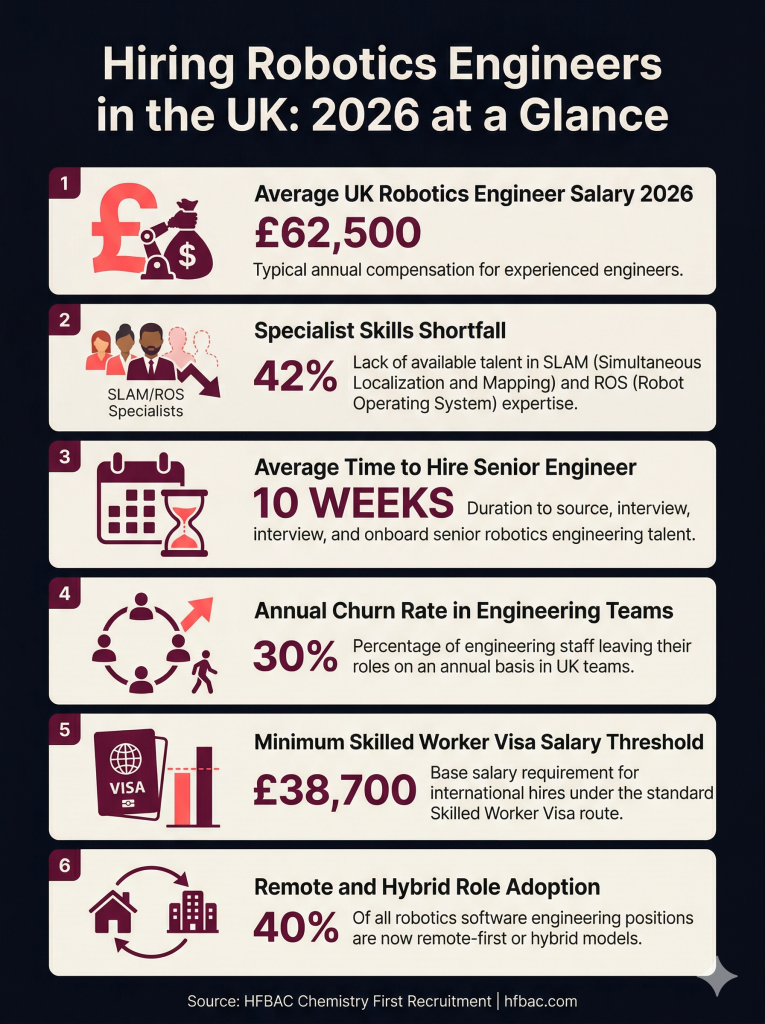
There’s a 42% shortfall in qualified SLAM and ROS specialists in the current market. That number comes from 2025 analysis, and if anything, the gap has widened since. Demand for engineers with experience in human-robot collaboration and edge computing has surged, and the pipeline of people with those specific skills hasn’t kept pace.
What this means practically: if you’re moving slowly, you’re losing. The best candidates at senior level typically hold three competing offers by the time they reach final interview stage. Your process needs to be crisp, respectful of their time, and genuinely compelling.
Where the talent actually is
The geographical picture is more nuanced than it used to be. London remains the primary hub for AI and software-defined robotics. Cambridge’s deep tech ecosystem produces roughly 22% of the country’s specialist hardware architects. Bristol’s Robotics Laboratory and Imperial College London are your best academic pipelines if you want to hire early-career researchers.
But here’s the shift: 40% of robotics software roles are now remote-first or hybrid. That means you’re no longer restricted to candidates within commuting distance. A strong ROS engineer in Edinburgh or Manchester is absolutely accessible to you – if your process and your employer brand are good enough to attract them.
The visa picture for international candidates
If you’re considering international candidates – and in this market, you probably should be – the Skilled Worker Visa is the primary route. As of April 2024, the minimum salary threshold sits at £38,700 for most roles. You’ll need a valid Home Office sponsorship licence to issue a Certificate of Sponsorship.
Get your sponsorship licence sorted before you start the search, not partway through it. I’ve seen founders lose excellent candidates because the paperwork wasn’t in place when the offer was ready to go. It’s a straightforward process, but it takes time.
Software vs Hardware: Getting the Role Definition Right
This is where a lot of hiring goes wrong before it even starts. There’s a significant difference between a robotics software engineer and a hardware engineer, and conflating the two – or assuming you need a ‘full-stack robotics engineer’ who can do everything – will either get you the wrong person or price you out of the market unnecessarily.
Robotics software engineers
Software specialists are working primarily within ROS 2 (the current standard is Humble or Iron distributions), writing in C++ for real-time performance and Python for higher-level logic. The skills you actually need to ask about: SLAM proficiency, computer vision using Transformer-based architectures, and simulation experience in NVIDIA Isaac Sim or Gazebo. If they’ve done serious mobile robotics work, SLAM isn’t optional – it’s the thing.
A robotics software engineer is not a general software developer who’s worked near robots. The difference is real and it matters. They understand 3D mathematics, sensor fusion, and the constraints of deploying code in physical environments. Don’t hire a general developer and hope they’ll pick it up fast enough.
Robotics hardware engineers
Hardware engineers are operating in the mechanical and electrical domain – mechatronic integration, CAD (typically SolidWorks), PCB design, power distribution, and structural integrity. If your product has physical components that need to work reliably in the real world, this is your person.
In early-stage UK startups – which made up 64% of new robotics ventures in 2025 – there’s a genuine need for what I’d call a Full-Stack Robotics Engineer: someone who can move across the full development lifecycle from PCB design to sensor fusion. They’re rare, they know they’re rare, and they’re priced accordingly. If that’s what you need, plan your budget and timeline around that reality.
Seniority matters more than title
Define the seniority level before you write the job description, not after. A junior engineer is handling deployment, maintenance, and clearly scoped technical tasks. A senior engineer is owning system-wide integration and making architectural decisions. The person you need at founding-team level is someone who can think at the architectural level now and manage a team in 18 months. Those aren’t the same as a good mid-level developer.
The Chemistry First Approach to Hiring Robotics Engineers
Here’s the statistic that shapes everything I do: 80% of new hire failures result from personality and values misalignment, not technical skill gaps. That’s consistent across sector and seniority level. And in robotics specifically, where teams are small, environments are pressured, and pivots happen constantly, the wrong hire doesn’t just underperform – they can genuinely destabilise a project.
Technical skill is the price of entry. Chemistry is what determines whether the hire works.
What Chemistry First looks like in practice for a robotics search
The process runs in three stages, and all three are non-negotiable in a search at this level.
- Stage 1 – Technical screening: A structured conversation to assess their ability to integrate complex systems under real constraints. For UK-based roles, this includes familiarity with relevant regulatory standards (the 2025 PSTI requirements matter if your product has connectivity). This isn’t a whiteboard coding test – it’s a conversation about how they actually think through technical problems.
- Stage 2 – The Chemistry Session: This is the stage most companies skip, and it’s the stage that saves you the most money. We’re assessing value alignment – does this person’s problem-solving approach match the way your founding team works? How do they handle ambiguity? What do they do when documentation is sparse and timelines are tight? What’s their relationship with failure?
- Stage 3 – Paid working trial: A four-hour collaborative session where they work on a real (or realistic) problem with your existing team. This isn’t free work – pay them for their time. You’re not assessing whether they can solve the problem. You’re watching how they communicate, how they respond to feedback, and how the dynamic feels with the people they’d actually be working alongside every day.
The red flags I watch for specifically in robotics candidates
Defensiveness about their code. In an environment where systems need to be debugged constantly and architectural decisions need to be revisited, someone who can’t handle challenge on their technical choices is going to be a liability.
No curiosity about the business. A robotics engineer joining an early-stage company needs to care about what you’re building and why. If they’re only interested in the technical problem and have no interest in the commercial reality around it, you’re going to have alignment issues the moment priorities need to shift.
Inability to communicate with non-engineers. This is critical in a founder-led team. If they can’t explain what they’re building to you in plain language during the interview, that won’t improve once they’re three months into a complex subsystem.
Avoiding pedigree bias
The UK robotics sector has a tendency to over-value degrees from a handful of institutions. I understand why – Bristol, Imperial, and Edinburgh produce genuinely excellent graduates. But data consistently shows that engineers with strong project-based experience outperform those with purely academic backgrounds in rapid prototyping environments. Use a structured scoring rubric. Evaluate against the actual role requirements. Don’t let a university name do the thinking for you.
Which Recruitment Model Is Right for You?
The decision about how to run your robotics search depends on your stage, your budget, and how many hires you’re looking at over the next 12 months. Here’s my honest breakdown.
Contingency recruitment: what you’re actually buying
The traditional agency model charges 20-30% of first-year salary on placement. On a £75,000 robotics engineering salary, that’s £15,000 to £22,500 per hire. The financial incentive for the agency is tied to the highest possible salary placement – which is structurally misaligned with your interests as a founder trying to build a sustainable payroll.
Generalist agencies also typically lack the specialist robotics network and technical understanding to assess candidates properly. They’re reading CV keywords, not evaluating engineering judgement. That’s not a criticism – it’s just a structural limitation of the model.
Contingency can work for volume hiring at junior level where the stakes per hire are lower. For senior or founding-team hires in robotics, it’s a risk.
Fractional Talent Partnership: what changes
A Fractional Talent Partner operates on a flat monthly retainer – embedded in your business, not sitting outside it waiting to place people. The financial model removes the conflict of interest. There’s no incentive to push salary higher, no incentive to rush a placement through before the chemistry work is done.
The data on this is consistent: companies using fractional talent partners see 22% higher candidate retention at 18 months compared to contingency placements. In robotics, where replacing a senior engineer costs upwards of £120,000 when you account for lost productivity and rehiring costs, that retention improvement is the ROI story.
The economics make more sense than they first appear. A flat monthly retainer covering multiple roles simultaneously is often cheaper overall than two or three contingency placements – and the output is better because the process is better.
Founder-led search: when it works and when it stops working
Running your own search works well up to a point. That point, in my experience, is when you’re looking for more than three specialist engineers per quarter. Beyond that, the time cost to the founder starts to outweigh the money saved on fees.
If you’re considering a founder-led search, the Hiring Health Check is a useful place to start. It gives you a clear picture of where your process has gaps before you’re mid-search and finding out the hard way.
Your Robotics Hiring Roadmap for 2026
If you’re planning a significant engineering hire this year, here’s the sequence I’d recommend.
- Step 1 – Audit your technical position: Before you write a single job description, understand what technical debt you’re carrying. Firms with unresolved architectural gaps see a 30% reduction in new hire productivity in their first 90 days. Bringing someone into a messy codebase without a clear picture of the state of things isn’t fair on them and isn’t useful for you.
- Step 2 – Write a chemistry-led brief, not a skills list: Your job description should communicate who you are as a founding team as clearly as it communicates what you need technically. What’s the product doing and why does it matter? What does the first 90 days look like? What’s the team culture? The best candidates have options – they’re choosing you as much as you’re choosing them.
- Step 3 – Decide your recruitment model before you start: Don’t pick a recruitment approach based on whoever contacts you first. Make a deliberate decision about whether you’re running this founder-led, using contingency, or engaging a fractional partner – and make that decision based on the seniority and criticality of the role.
- Step 4 – Build your pipeline 24 weeks out from when you need someone: This isn’t a process you can compress. If your 2026 roadmap includes a specific technical milestone, your hiring pipeline for the person who’s going to deliver it needs to start now. Senior robotics engineers are not quick to hire.
Not Sure If You’re Ready to Start This Search?
Before you start a search at this level, it’s worth taking 20 minutes to understand what’s working and what isn’t in your current approach. The Hiring Health Check is free, it’s honest, and it gives you a clear picture of where the risk is.
Book your free Hiring Health Check
Frequently Asked Questions
What is the average salary for a robotics engineer in the UK in 2026?
The UK market average is projected to reach £62,500 by Q2 2026. Entry-level positions typically start around £42,000. Senior specialists in London or Cambridge regularly command £95,000 or above. These figures represent roughly 4.5% annual growth since 2023. Build these benchmarks into your hiring budget early – underpricing a senior robotics engineer at offer stage is one of the most expensive mistakes I see founders make.
How do I tell the difference between a robotics software engineer and a general developer?
A robotics software engineer works in low-latency systems with direct hardware interaction. They need proficiency in C++ and ROS, strong 3D mathematics, and real experience with sensor fusion and simulation testing. A general developer works at the application layer and typically doesn’t have the hardware integration background. The distinction matters – hire the wrong type and you’ll lose months.
Contractor or permanent employee – which is right for a robotics hire?
Permanent employees are the right choice for roles involving core IP development and long-term product ownership. Contractors make sense for specific six-month technical phases – bridging a capacity gap during intensive development or covering a specialism you need for a defined project. Your decision should be driven by the duration and the IP sensitivity of the work, not by what’s cheapest in the short term.
Which UK universities produce the best robotics engineering talent?
Imperial College London, the University of Bristol, and the University of Edinburgh are the three strongest pipelines in 2026. Imperial’s Dyson School of Design Engineering produces over 40 high-calibre graduates annually. Bristol’s Robotics Laboratory is a strong source of PhD-level autonomous systems researchers. That said – as I noted earlier – don’t let institutional pedigree be your primary filter. Some of the best robotics engineers I’ve placed came from institutions outside the usual list.
How long does it typically take to hire a senior robotics engineer in the UK?
Expect ten weeks as your baseline, and plan for longer if you need a very specific specialisation. The process typically involves a two-week initial screening phase, followed by technical assessment and chemistry sessions, then final-stage conversations. At senior level, your preferred candidate is likely in conversation with at least two other companies simultaneously. Move decisively when you’ve found the right person.
What are the main visa requirements for hiring international robotics talent?
The Skilled Worker Visa is the primary route. The minimum salary threshold is £38,700 (established April 2024). You need a valid Home Office sponsorship licence to issue a Certificate of Sponsorship. The 70-point eligibility system assesses English proficiency and job suitability. Get your sponsorship licence in place before your search begins – don’t let admin timelines cost you a strong candidate at offer stage.
What’s the difference between a fractional talent partner and a recruitment agency?
A fractional talent partner operates on a retained, flat-fee basis – embedded in your business rather than sitting outside it. A traditional recruitment agency works on contingency, earning a percentage of placement salary. The fractional model removes the salary inflation incentive, integrates the partner into your culture and process, and typically produces better retention outcomes. For specialist technical hiring, it’s the approach I consistently recommend to founders.
How does the Chemistry First methodology actually reduce hiring risk?
80% of new hire failures come from values and personality misalignment, not missing technical skills. Chemistry First puts the cultural and motivational assessment at the centre of the process – not as a nice-to-have at the end, but as a structured stage that informs the whole decision. The result is higher retention, better team cohesion, and fewer expensive mistakes. In a sector where replacing a senior engineer can cost £120,000 or more in total, the methodology pays for itself quickly.
About the Author
Helen Wingrove-Sanders is the founder of HFBAC (Hiring For and Building Awesome Companies) and creator of the Chemistry First recruitment methodology. With 27 years of experience placing people into UK and US tech companies, she works exclusively with bootstrapped and founder-led businesses. She began her career at the BBC as the first female football commentator in the organisation’s history – watching teams succeed or fail based on chemistry rather than individual talent shaped everything she now does in recruitment.
Helen runs hiring workshops with the British Library’s BIPC and Virgin StartUp. She is the author of Hire Ready, Book 1 of The Bootstrapped Founder’s Hiring Trilogy, published under Wingrove Publishing. She holds dual British-American citizenship and works with founders across the UK and US.
Based in Bristol, England.
Related: Why Your Robotics Startup Can’t Find Engineers (And What To Do About It)
You might also like: Read next