Skip to content
Every founder hits the same wall.
Revenue is growing. Customers are landing. The to-do list is out of control.
And the obvious answer seems simple.
“We just need to hire more people.”
I hear this sentence at least twice a week. And every time, I think about the same thing.
A formula most founders have never seen.
______________________________
The Maths Nobody Tells You About
When you have 3 people on a team, there are 3 communication lines between them. Three relationships that need to work.
Simple. Manageable. You can probably picture it.
Now double that team to 6 people.
You don’t get 6 communication lines. You get 15.
Double again to 12 people. You now have 66 communication lines.
Go to 14 and you’re managing 91 relationships.
The formula is n x (n – 1) / 2 where n is the number of people on the team.
Here’s what that looks like in practice: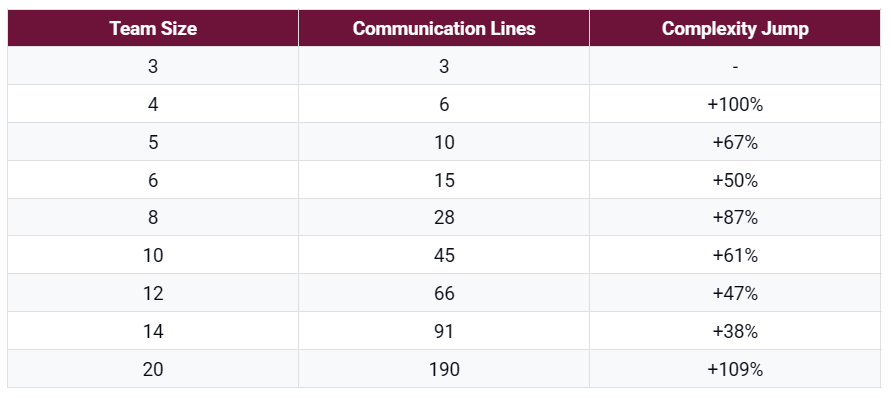
Read that table slowly.
Going from 3 people to 6 people doubles your headcount. But it multiplies your communication complexity by five.
This isn’t theory. It’s the reason your Slack channels feel chaotic, your meetings run long, and decisions that used to take five minutes now take five days.
______________________________
Why This Matters More Than Your Org Chart
Most founders plan their growth in headcount. “We need two more engineers and a marketing person.”
What they don’t plan for is the invisible web of relationships that comes with every new person.
Every hire you make doesn’t just bring their skills to the table.
They create a brand new relationship with every single person already on the team.
New dynamics.
New friction points.
New communication channels that all need to function.
And here’s the part that keeps me up at night after 27 years of building founding teams.
If even one of those lines is broken, the whole system feels it.
One person who doesn’t fit. One hire made in a rush because you were drowning. One team member who interviews brilliantly but clashes with everyone once they start.
At 4 people, a bad relationship is uncomfortable but contained.
At 12 people, a bad relationship ripples through 66 connections. It changes the temperature of every meeting. It slows every decision. It makes your best people start looking elsewhere.
______________________________
The Real Cost of “Just Hire More People”
I’ve watched this pattern play out hundreds of times.
Founder hits a growth wall. Revenue is there, but delivery is suffering. The team is stretched thin.
So they hire fast.
Two new people in month one. Another three by month three.
Six months later, the team has doubled but output hasn’t. Communication has broken down. The original team members are frustrated. The new hires feel lost.
The founder calls me and says the same thing every time.
“I don’t understand. We hired great people. Why isn’t it working?”
Because they hired for skills without thinking about communication lines.
They added nodes to the network without checking if the existing network was healthy.
______________________________
What Smart Founders Do Instead
The founders I’ve seen get this right don’t hire fewer people. They hire more deliberately.
They check the existing lines first. Before adding anyone new, they make sure the relationships already on the team are strong. Are people communicating well? Are conflicts being resolved? Is there trust?
They hire for chemistry, not just credentials. A candidate’s ability to integrate into the existing web of relationships matters as much as their technical skills. Maybe more.
They grow in stages. Adding one person, letting the team absorb the new communication lines, then adding the next. Not dumping five new hires into a system that’s already stretched.
They invest in onboarding properly. Every new hire needs to build a working relationship with every existing team member. That doesn’t happen by accident. It takes time, structure, and intention.
______________________________
Six People With Chemistry Beat Twelve Without It
This is the thing I come back to again and again.
I learned it in the BBC press box before I ever set foot in a recruitment office.
The teams that won weren’t always the most talented. They were the ones where people just clicked. Where communication was fast, trust was high, and everyone knew their role.
The same is true in startups.
A team of 6 with strong communication lines – where every one of those 15 relationships is healthy – will outperform a team of 12 where half the 66 lines are strained, broken, or ignored.
Headcount is vanity.
Connection quality is the metric that actually predicts performance.
______________________________
Before You Post That Job Ad
If you’re planning to grow your team, pause for a moment.
Don’t start with “who do we need to hire?”
Start with “are the communication lines we already have actually working?”
If the answer is no – or even “I’m not sure” – that’s the first thing to fix.
Adding more people to a broken communication system doesn’t fix the system. It makes it exponentially more broken.
The maths guarantees it.
______________________________
Not sure if your team’s communication lines are healthy?
The HFBAC Hiring Health Check is a 30-minute diagnostic that maps where your team stands right now – before you add anyone new.
Book your Hiring Health Check here
______________________________